Student Loan Forgiveness 2026: Updates & Eligibility

Navigating student loan forgiveness programs 2026 requires understanding the evolving eligibility criteria and application processes for US borrowers seeking to alleviate their educational debt obligations.
For millions of Americans, student loan debt represents a significant financial burden, often impacting major life decisions. As we approach 2026, many borrowers are eagerly seeking clarity on the future of student loan forgiveness. This article aims to provide a comprehensive guide to student loan forgiveness programs 2026, detailing the latest updates, essential eligibility requirements, and how US borrowers can navigate these crucial pathways to financial relief. Understanding these programs is not just about policy; it’s about empowering individuals to make informed decisions about their financial future.
The evolving landscape of student loan forgiveness
Student loan forgiveness in the United States has been a dynamic and often complex area of federal policy. Over the past few years, we’ve witnessed significant shifts, including temporary pauses on payments, new initiatives, and adjustments to existing programs. These changes reflect ongoing efforts by policymakers to address the growing student debt crisis, but they also create a need for borrowers to stay continuously informed.
The landscape of student loan forgiveness is not static; it’s subject to legislative action, administrative review, and economic shifts. What was true last year might not be entirely accurate for 2026. Therefore, a proactive approach to understanding these developments is essential for anyone hoping to benefit from forgiveness opportunities.
Recent policy changes affecting forgiveness
- The Biden-Harris administration has introduced various measures aimed at simplifying access to existing forgiveness programs and providing targeted relief.
- Adjustments to income-driven repayment (IDR) plans have been a significant focus, aiming to reduce monthly payments and accelerate forgiveness for long-term borrowers.
- There have been ongoing discussions and proposals for broader, more universal forgiveness, though the implementation of such large-scale plans remains a subject of debate and legal challenges.
The continuous evolution means that borrowers must regularly check official sources and understand how new policies might impact their specific situation. Relying on outdated information could lead to missed opportunities or incorrect financial planning. The goal for 2026 is often to streamline processes and ensure that eligible borrowers can access the relief they are entitled to.
In conclusion, the student loan forgiveness landscape is constantly evolving. Staying informed about recent policy changes and administrative updates is paramount for US borrowers. These adjustments can significantly alter eligibility criteria and the path to debt relief, making continuous monitoring of official announcements a key strategy for success.
Key federal student loan forgiveness programs for 2026
Several federal programs offer pathways to student loan forgiveness, each designed to assist specific groups of borrowers or those meeting particular criteria. For 2026, these programs continue to be the primary avenues for relief, though their rules and administration may see further refinements. It’s vital to differentiate between these programs as eligibility and benefits vary considerably.
These programs are generally not automatic; they require direct action from the borrower, including enrollment, consistent payments, and sometimes specific employment. Understanding the nuances of each can help borrowers identify the best fit for their circumstances.
Public Service Loan Forgiveness (PSLF)
PSLF remains a cornerstone program for those working in public service. It forgives the remaining balance on Direct Loans after 120 qualifying monthly payments while working full-time for a qualifying employer. This includes government organizations at any level (federal, state, local, or tribal), and not-for-profit organizations that are tax-exempt under Section 501(c)(3) of the Internal Revenue Code.
- Eligibility: Must have Direct Loans, make 120 qualifying payments, and work full-time for a qualifying employer.
- Key Updates: Recent temporary waivers have expanded eligibility for past payments, but for 2026, borrowers generally need to adhere to the standard PSLF rules.
- Application: Requires submitting an Employment Certification Form annually or when changing employers, and a final application for forgiveness after 120 payments.
The PSLF program has undergone significant improvements in recent years to address past administrative issues, making it more accessible and transparent for eligible public servants. For 2026, the focus will likely remain on ensuring smooth processing and clear communication for applicants.
Teacher Loan Forgiveness (TLF)
The TLF program is specifically designed to encourage individuals to enter and remain in the teaching profession. It allows for up to $17,500 in loan forgiveness for highly qualified teachers who serve for five consecutive complete academic years in low-income schools or educational service agencies.
- Eligibility: Must be a highly qualified teacher (as defined by federal law), teach full-time for five consecutive years in a low-income school, and have certain types of federal loans.
- Benefit Amount: Up to $17,500 for mathematics, science, or special education teachers; up to $5,000 for other eligible teachers.
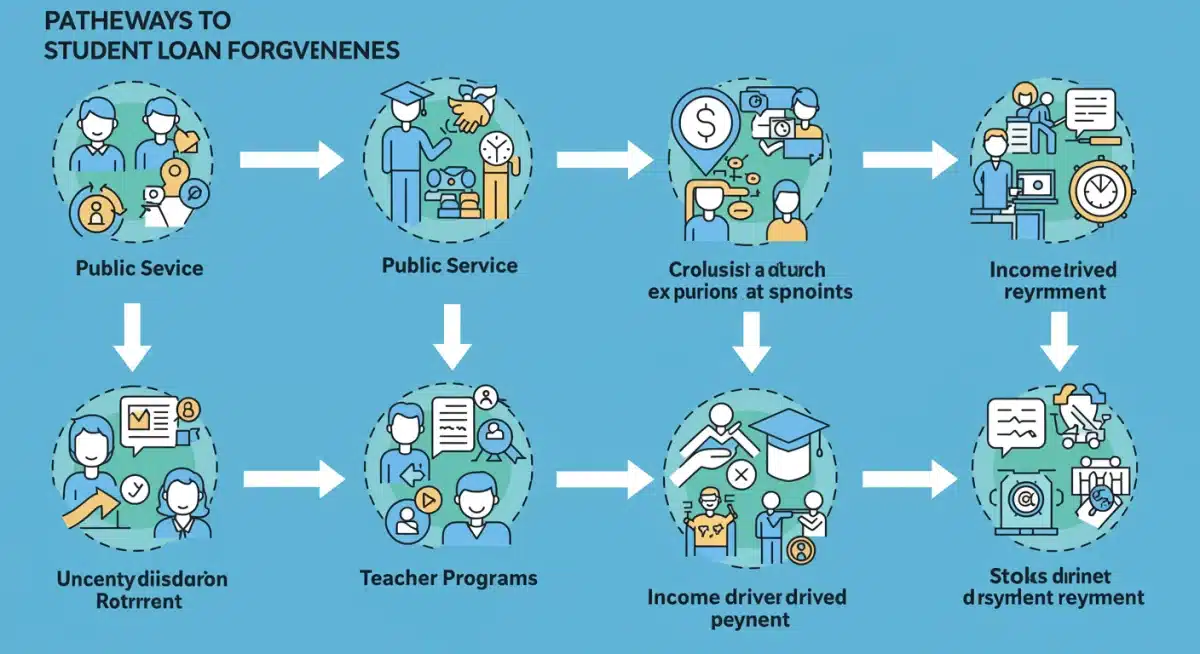
Understanding these specific federal programs is the first step toward determining which path to forgiveness might be available. Each program has unique requirements that must be met consistently over time. Borrowers should carefully review the criteria for 2026 to ensure they are on the right track.
In summary, federal programs like PSLF and TLF offer structured pathways to loan forgiveness for specific professions. Borrowers need to diligently meet the eligibility criteria and follow the application procedures to benefit from these opportunities in 2026.
Income-driven repayment (IDR) plans and forgiveness
Income-driven repayment (IDR) plans are crucial for many borrowers, as they cap monthly loan payments based on income and family size. A key feature of IDR plans is that any remaining loan balance is forgiven after 20 or 25 years of qualifying payments, depending on the specific plan and loan type. For 2026, these plans continue to be a vital safety net.
The appeal of IDR plans lies in their ability to make student loan payments more manageable, especially for those with lower incomes relative to their debt. The forgiveness aspect provides a long-term solution for borrowers who may never fully repay their loans under standard plans.
Understanding the new SAVE plan
The Saving on a Valuable Education (SAVE) Plan, which fully launched in 2024, is an enhanced IDR plan designed to significantly reduce monthly payments and provide more generous forgiveness terms. The SAVE Plan replaces the REPAYE Plan and offers several improvements:
- Lower Payments: Payments are calculated based on a smaller percentage of discretionary income compared to other IDR plans.
- Interest Subsidy: If your calculated payment doesn’t cover the monthly interest, the government covers the unpaid interest, preventing your loan balance from growing.
- Faster Forgiveness: Some borrowers with smaller original loan balances may qualify for forgiveness in as little as 10 years, rather than 20 or 25.
The SAVE Plan is particularly beneficial for borrowers with lower incomes and those with undergraduate loans, as it aims to make payments more affordable and accelerate the path to forgiveness. It represents a significant step towards making IDR plans more effective and accessible for a broader range of borrowers.
For 2026, borrowers currently on other IDR plans should evaluate whether switching to the SAVE Plan would be advantageous. The Department of Education provides tools and resources to help borrowers compare plans and understand their potential benefits. The key is to ensure you are enrolled in the plan that best suits your current financial situation and long-term goals for loan repayment and forgiveness.
In conclusion, IDR plans, particularly the new SAVE Plan, are essential for managing student loan debt and achieving forgiveness. Borrowers should actively explore these options for 2026 to ensure they are on the most beneficial repayment path.
Eligibility requirements for US borrowers in 2026
Understanding the specific eligibility requirements for each student loan forgiveness program is paramount. While some general rules apply across programs, each has unique criteria related to loan type, employment, payment history, and income. As of 2026, these requirements are largely stable but borrowers should always verify the latest details.
Misinterpreting eligibility rules is a common pitfall that can lead to disappointment. It’s not enough to simply wish for forgiveness; one must actively meet and maintain the specified conditions over time.
General eligibility considerations
- Loan Type: Most federal forgiveness programs primarily apply to Direct Loans. FFEL Program loans and Perkins Loans typically need to be consolidated into a Direct Consolidation Loan to qualify.
- Employment: Programs like PSLF and TLF have strict employment requirements regarding the type of employer and duration of service.
- Payment History: Consistent, on-time payments (or qualifying non-payments, such as those during COVID-19 administrative forbearance) are critical.
- Income: IDR plans factor in your adjusted gross income (AGI) and family size to determine monthly payments and, ultimately, the forgiveness timeline.
Borrowers should also be aware that some forgiveness programs are subject to taxation. While federal student loan forgiveness has been temporarily tax-free at the federal level through 2025, the tax implications for 2026 and beyond could vary depending on legislative action. It’s advisable to consult with a tax professional regarding potential state and federal tax liabilities on forgiven amounts.
Maintaining accurate records of your payments, employment, and communication with your loan servicer is crucial. This documentation can be invaluable if there are discrepancies or issues with your application for forgiveness. Proactive record-keeping can save a lot of stress down the line.
In summary, eligibility for student loan forgiveness programs in 2026 hinges on specific loan types, employment, and payment adherence. Borrowers must meticulously meet these criteria and be prepared for potential tax implications.
The application process and documentation
Once you’ve identified a student loan forgiveness program that aligns with your circumstances, the next critical step is navigating the application process. This often involves submitting specific forms, providing documentation, and potentially communicating with your loan servicer. The process can seem daunting, but breaking it down into manageable steps can help.
A well-prepared application, supported by accurate documentation, significantly increases the chances of a smooth and successful outcome. Rushing or overlooking details can lead to delays or even rejection.
Steps to apply for forgiveness
- Identify the Correct Program: Ensure you are applying for the program that best fits your eligibility (e.g., PSLF, TLF, or an IDR plan).
- Gather Required Documentation: This typically includes proof of employment (for PSLF/TLF), income verification (for IDR), and loan statements.
- Complete the Application Form: Fill out the specific application form for your chosen program, ensuring all information is accurate and complete.
- Submit to Your Loan Servicer: Most applications are submitted through your federal loan servicer or directly to the Department of Education.
- Track Your Application: Keep copies of all submitted documents and communications. Follow up periodically to ensure your application is progressing.
For PSLF, it’s highly recommended to submit the Public Service Loan Forgiveness (PSLF) & Temporary Expanded PSLF (TEPSLF) Certification & Application Form annually or whenever you change employers. This helps ensure your employment is certified and your qualifying payments are being tracked correctly from the start, avoiding potential issues at the time of your final forgiveness application.
For IDR plans, you generally need to re-certify your income and family size annually. Failure to re-certify can lead to your monthly payments increasing or being placed on a standard repayment plan, which could delay your forgiveness timeline.
The importance of accurate and timely documentation cannot be overstated. Any discrepancies or missing information can cause significant delays. Utilizing online portals provided by your loan servicer can often streamline the submission process and provide a digital record of your interactions.
In conclusion, the application process for student loan forgiveness in 2026 demands careful attention to detail and thorough documentation. Proactive engagement with your loan servicer and timely submission of forms are key to a successful outcome.
Potential challenges and how to overcome them
While student loan forgiveness programs offer significant relief, borrowers may encounter various challenges during the process. These can range from administrative hurdles to changes in policy or personal circumstances. Anticipating these issues and knowing how to address them can save time and reduce frustration.
Navigating the complexities of federal student aid can be difficult, and problems often arise. Being prepared for these potential roadblocks is as important as understanding the programs themselves.
Common obstacles and solutions
- Incorrect Payment Counts: Borrowers sometimes find their qualifying payment counts are inaccurate. Regularly check your payment history with your loan servicer and the Department of Education. If there’s a discrepancy, dispute it with documentation.
- Employer Eligibility Issues: For PSLF, ensuring your employer qualifies can sometimes be an issue. Always use the PSLF Help Tool to confirm employer eligibility. If your employer is not listed, they can submit an application for review.
- Loan Type Discrepancies: Having the wrong type of loan (e.g., FFEL or Perkins instead of Direct Loans) can prevent forgiveness. Consolidate these loans into a Direct Consolidation Loan if necessary.
- Administrative Delays: High volumes of applications can lead to processing delays. Be patient but persistent in following up on your application status.
Staying organized is one of the most effective strategies for overcoming challenges. Keep a dedicated folder, digital or physical, for all student loan-related correspondence, payment records, and application forms. This ensures you have immediate access to any information needed for disputes or inquiries.
Seeking assistance from reliable sources is also crucial. The Federal Student Aid (FSA) website (StudentAid.gov) is the official and most authoritative source for information on federal student loan programs. Your loan servicer can also provide specific guidance related to your account. For complex situations, consider consulting with a non-profit student loan counselor.
It is important to avoid third-party companies that promise quick fixes or charge fees for services that are available for free through official channels. Many of these companies are scams and can put your financial information at risk.
In conclusion, challenges in the student loan forgiveness process are common, but they can be overcome with diligence, organization, and by seeking help from official and trusted resources. Proactive problem-solving is key to successfully achieving forgiveness.
Planning for your financial future beyond forgiveness
Achieving student loan forgiveness is a significant milestone, but it’s also an opportunity to re-evaluate and plan for your broader financial future. Forgiveness doesn’t just eliminate debt; it frees up resources that can be redirected toward other financial goals, such as saving for retirement, a down payment on a home, or further education.
The relief from student loan payments can be a powerful catalyst for positive financial change. It’s important to have a strategy for how to best utilize this newfound financial flexibility.
Strategies for post-forgiveness financial planning
- Build an Emergency Fund: If you haven’t already, prioritize building a robust emergency fund (3-6 months of living expenses) to cover unexpected costs without incurring new debt.
- Increase Retirement Contributions: Maximize contributions to your 401(k), IRA, or other retirement accounts. The earlier you start, the more compound interest works in your favor.
- Address Other Debts: Use the freed-up funds to pay down high-interest debts, such as credit card balances, which can significantly improve your overall financial health.
- Invest in Yourself: Consider investing in career development, additional certifications, or starting a business. This can increase your earning potential over the long term.
- Review Your Budget: Revisit your budget to reflect your new financial situation. Ensure your spending aligns with your values and long-term goals.
It’s also important to consider the psychological impact of being debt-free. The absence of student loan payments can reduce stress and open up new possibilities. This can be a great time to set new financial goals and work towards achieving them with renewed vigor. The discipline learned during years of repayment can be channeled into other areas of financial management.
Furthermore, staying informed about economic trends and personal finance best practices will continue to be beneficial. Financial planning is an ongoing process, not a one-time event. Regularly reviewing your financial health and adjusting your strategies as needed will ensure long-term stability and growth.
In conclusion, student loan forgiveness is a stepping stone to a more secure financial future. By strategically reallocating funds and focusing on key financial goals, borrowers can transform debt relief into lasting financial well-being.
| Key Point | Brief Description |
|---|---|
| Evolving Landscape | Student loan policies are dynamic; continuous monitoring of federal updates is essential for 2026. |
| Federal Programs | PSLF and TLF offer targeted forgiveness for public service and teaching, with specific criteria. |
| IDR & SAVE Plan | Income-Driven Repayment plans, especially the new SAVE Plan, provide payment caps and long-term forgiveness. |
| Application Process | Accurate documentation, timely submissions, and regular follow-ups are crucial for success. |
Frequently Asked Questions about 2026 Student Loan Forgiveness
In 2026, the primary federal forgiveness programs include Public Service Loan Forgiveness (PSLF), Teacher Loan Forgiveness (TLF), and Income-Driven Repayment (IDR) plan forgiveness, notably through the new SAVE Plan. Each program targets specific borrower groups or repayment behaviors, offering distinct pathways to debt relief for eligible US borrowers.
The SAVE Plan significantly lowers monthly payments by reducing the percentage of discretionary income used for calculations and prevents loan balances from growing due to unpaid interest. It also offers faster forgiveness for some borrowers, with relief possible in as little as 10 years depending on the original loan amount, making it a crucial option for 2026.
To qualify for PSLF in 2026, borrowers must have Direct Loans, make 120 qualifying monthly payments, and be employed full-time by a qualifying government or non-profit organization. Regularly submitting the Employment Certification Form is vital to track progress and ensure eligibility throughout the repayment period.
While federal student loan forgiveness has been federally tax-free through 2025, the tax implications for 2026 and beyond depend on future legislative action. Borrowers should consult a tax professional to understand any potential federal or state tax liabilities on forgiven amounts, as this can vary and impact overall financial planning.
Borrowers should first identify the correct program, gather all required documentation (employment verification, income proof), complete the specific application form accurately, and submit it to their loan servicer or the Department of Education. Consistent follow-up and meticulous record-keeping are essential for a successful application process.
Conclusion
As we look towards 2026, the landscape of student loan forgiveness programs for US borrowers continues to offer vital avenues for financial relief. Understanding these programs—from the established PSLF and TLF to the transformative SAVE Plan—is not merely about navigating bureaucracy; it’s about empowering individuals to make informed decisions that can significantly impact their financial well-being. Diligence in understanding eligibility, meticulous application, and proactive financial planning post-forgiveness are all crucial steps. By staying informed and engaged with official resources, borrowers can effectively pursue the debt relief they are entitled to, paving the way for a more secure and prosperous future.